Absolute Value Equations
Absolute value measures distance from zero on the number line, and distance is never negative. That single fact drives everything that follows. The notation $|x|$ means "how far is $x$ from zero", so
Because both $5$ and $-5$ sit five units from zero, an absolute value equation usually has two solutions. Forgetting the second one is the classic mistake.
Solving a Basic Equation
Consider $|x - 3| = 7$. The expression inside must be $7$ units from zero, so it could equal either $7$ or $-7$:
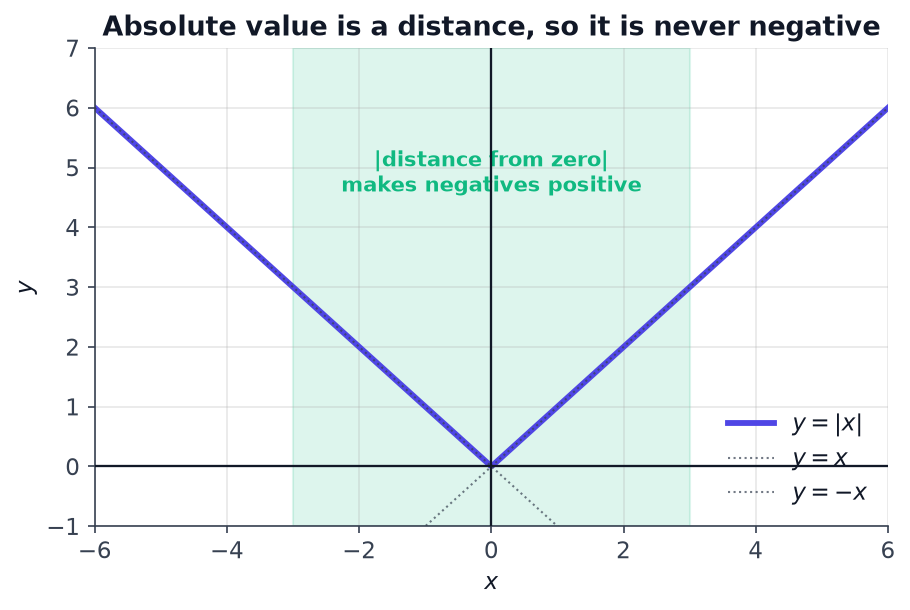
Solving both gives $x = 10$ or $x = -4$. Substituting each back confirms both work, and the graph shows why: the V-shaped curve crosses the horizontal line $y = 7$ at exactly two points.
The general pattern is clean. For any positive $c$,
There is one important exception. If $c$ is negative, the equation $|A| = c$ has no solution, because a distance can never be negative. If $c = 0$, there is exactly one solution, $A = 0$.
Isolating the Absolute Value First
Before splitting into two cases, the absolute value must stand alone on one side. Worked example. Solve $3|x + 1| - 4 = 8$.
Add $4$ to both sides, then divide by $3$:
Now split. Either $x + 1 = 4$, giving $x = 3$, or $x + 1 = -4$, giving $x = -5$. The solution set is $\{-5, 3\}$. Attempting to split before removing the $3$ and the $-4$ is where most errors creep in.
Absolute Value Inequalities
Inequalities are best read as statements about distance. The inequality $|x| < 3$ asks "which points are less than three units from zero", which is the open interval
Conversely, $|x| > 3$ describes points more than three units away, so the answer is two separate rays:
The memory hook is that "less than" compresses to a single interval while "greater than" splits into two. Reading each inequality aloud as a sentence about distance makes the correct shape obvious.
Distance Between Two Points
There is a second way to read absolute value that clears up many problems: $|x - a|$ is the distance from $x$ to the number $a$ on the number line. Under this reading, the equation $|x - 4| = 2$ asks "which numbers sit exactly two units from $4$", and the answer is immediate:
This interpretation explains the two-case rule without any algebra. It also generalises directly: $|x - a| < r$ describes every point within a distance $r$ of $a$, a neat single interval. That phrasing is exactly how engineers state a tolerance. A bolt specified as $10$ mm with a tolerance of $0.05$ mm satisfies
meaning any measurement from $9.95$ to $10.05$ is accepted. Absolute value, seen this way, is simply controlled precision.
Common Mistakes to Watch For
The single most frequent error is dropping the negative case and reporting only one solution. A second mistake is splitting too early, before the absolute value is isolated. A third is forgetting to check for extraneous solutions when the equation is more complex than $|A| = c$; always substitute both answers back and discard any that fail.
Key takeaway: isolate the absolute value, split into a positive and a negative case, and remember that a distance can never equal a negative number.
Practice it: try the equation solver or generate a practice set on this topic.