Exponents and Radicals
Exponents are shorthand for repeated multiplication. Writing $2^5$ means $2 \cdot 2 \cdot 2 \cdot 2 \cdot 2 = 32$, where the base $2$ is multiplied by itself five times. Once repeated multiplication becomes this compact, algebra can manipulate powers using a small set of rules that apply everywhere — and those rules are what this guide is really about.
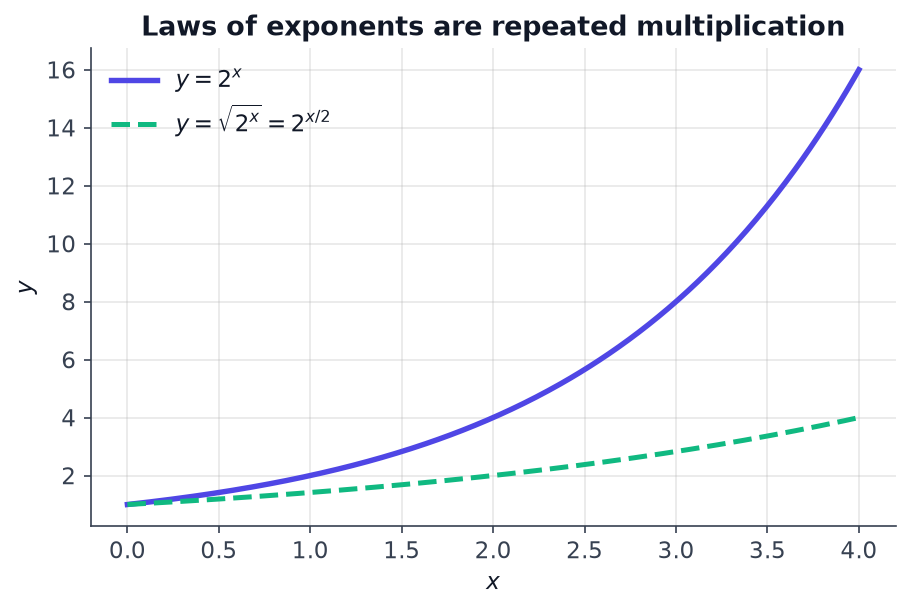
Radicals and exponents are two sides of the same coin. The square root of $x$ is just $x$ raised to a fractional power, which means every radical problem can be rewritten as an exponent problem.
The Core Laws
For any base $a$ and integers $m$ and $n$, the rules are:
Notice the pattern in the first two: multiplication of powers adds exponents, while division subtracts them. The third rule turns a power of a power into multiplication.
Two special cases deserve their own line. Any nonzero base raised to the zero power equals one,
and a negative exponent means reciprocal,
So $2^{-3}$ is $\frac{1}{8}$, not $-8$. Negative exponents never change the sign of the result.
Rewriting Radicals
A square root is a fractional exponent:
Combined with the power rule, this gives the extremely useful conversion
Rationalizing a denominator becomes simple too. Multiplying $\frac{1}{\sqrt{2}}$ by $\frac{\sqrt{2}}{\sqrt{2}}$ gives $\frac{\sqrt{2}}{2}$, which is just $2^{-1/2} \cdot 2^{1/2}$ reasoning in disguise.
Worked Example: Simplifying an Expression
Simplify $\dfrac{6x^{3}y^{-2}}{2x^{-1}y^{4}}$ and write the answer with positive exponents. Start with the numerical coefficients, then apply the quotient law to each base separately:
The subtlety is the double negative in the exponent of $x$. Subtracting $-1$ adds $1$, so the power of $x$ rises from $3$ to $4$. Converting the remaining negative exponent gives the final form $3x^4 / y^6$.
Now expand the expression $\left(2x^{2}y\right)^{3}$. Apply the power rule to each factor inside the bracket, because the exponent distributes across a product:
A worthwhile contrast is the expression $x^{2} \cdot x^{3} + x^{5}$. The first product combines to $x^{5}$ by the addition law, giving $x^{5} + x^{5} = 2x^{5}$. Students frequently write $x^{5} + x^{5} = x^{10}$, which is wrong twice over: it adds exponents across a sum and then drops the coefficient. Exponent laws govern multiplication and division only. Addition requires the much simpler rule that you may combine like terms, nothing more.
Quick Reference
It helps to keep the common conversions in one place:
| Radical form | Exponential form |
|---|---|
| $\sqrt{x}$ | $x^{1/2}$ |
| $\sqrt[3]{x}$ | $x^{1/3}$ |
| $\dfrac{1}{\sqrt{x}}$ | $x^{-1/2}$ |
| $\sqrt{x^5}$ | $x^{5/2}$ |
Reading the table in either direction removes most hesitation. If a problem arrives in radical form, convert it to a fractional exponent and use the three core laws. If an answer arrives with a negative exponent, move the base across the fraction line. Working fluently between the two notations is the real objective of this guide, because every later topic from trigonometry to calculus assumes it is already second nature.
Common Mistakes to Watch For
The single most common error is adding exponents when you should not. The expression $x^2 + x^3$ cannot be combined — there is no law that merges a sum of powers. Only products and quotients allow exponent arithmetic.
A second trap is the sign of a root. While $\sqrt{9} = 3$ by the standard convention that the radical returns the non-negative root, the equation $x^2 = 9$ has two solutions, $x = 3$ and $x = -3$. Always remember which direction you are travelling: taking a square root versus squaring.
Key takeaway: convert every radical into a fractional exponent, apply the three core laws, and never combine terms across a plus or minus sign.
Practice it: try the equation solver or generate a practice set on this topic.