Factoring Polynomials
Factoring is the algebra of rewriting an expression as a product of simpler pieces. Where expansion multiplies brackets together, factoring runs the process backwards. It matters because a factored polynomial reveals its roots immediately: once you can read off where each factor equals zero, solving equations becomes almost effortless.
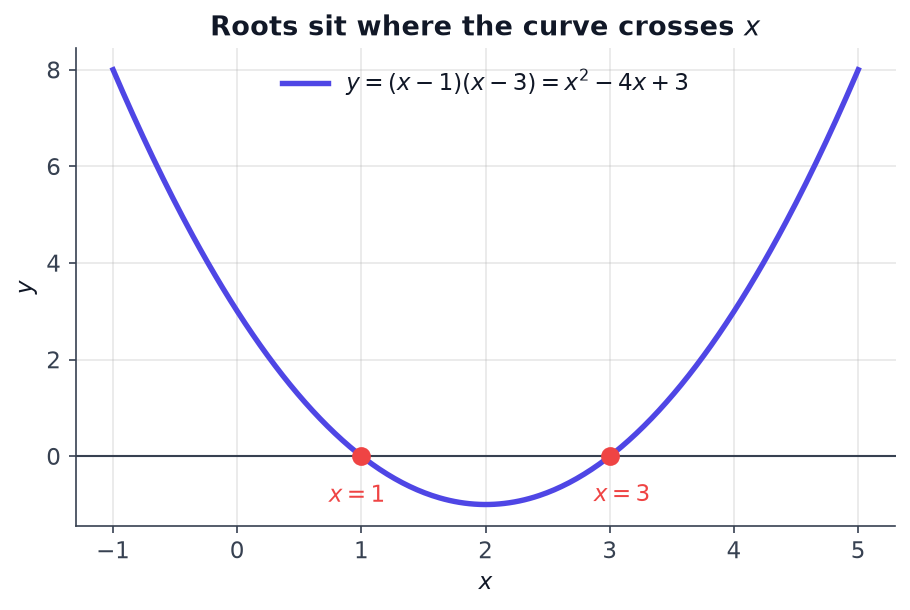
The goal is always the same. Given something like $x^2 - 4x + 3$, find two expressions whose product gives it back. Here the answer is $(x-1)(x-3)$, and from that form the roots $x = 1$ and $x = 3$ are visible at a glance.
The Basic Patterns
Three structures cover most of the work. The difference of squares says
so $x^2 - 9$ factors immediately as $(x-3)(x+3)$. Note carefully that a sum of squares, such as $x^2 + 9$, does not factor over the real numbers.
The perfect square trinomial pattern is
which turns $x^2 + 6x + 9$ into $(x+3)^2$.
For a general quadratic $x^2 + bx + c$, you are hunting for two numbers that multiply to $c$ and add to $b$. For $x^2 - 4x + 3$, the numbers $-1$ and $-3$ multiply to $3$ and add to $-4$, giving $(x-1)(x-3)$.
When the Leading Coefficient Is Not One
For $2x^2 + 7x + 3$ the search is slightly harder because the first terms must multiply to $2x^2$. Use the ac-method: multiply $a \cdot c = 2 \cdot 3 = 6$, then find a pair multiplying to $6$ and adding to $7$ — that pair is $1$ and $6$. Split the middle term and group:
Factoring Completely
A factorization is only finished when no factor can be split further. The practical order of operations is: pull out the greatest common factor, then apply the difference of squares, then attempt a quadratic pattern. Consider $3x^4 - 48$. The common factor of $3$ gives $3(x^4 - 16)$, and the bracket is a difference of squares written as the square of $x^2$, so it becomes $3(x^2 - 4)(x^2 + 4)$. The first bracket is itself a difference of squares and splits again, while the sum of squares does not. The complete answer is therefore
Stopping at $3(x^2 - 4)(x^2 + 4)$ would cost marks, because a factor was left unfinished. A quick verification helps: expand the degrees and confirm the leading term returns $3x^4$, then expand the constant terms and confirm they return $-48$.
Worked Example
Solve $x^3 - 4x = 0$ completely. A common instinct is to divide both sides by $x$, but that silently destroys the solution $x = 0$. Instead, factor out $x$ first:
The bracket is a difference of squares, so the expression factors further into $x(x-2)(x+2) = 0$. By the zero product property, a product equals zero only when one of its factors equals zero, which gives three separate equations:
So the solution set is $x \in \{-2,\, 0,\, 2\}$. Substituting each value back into the original cubic confirms all three work. The lesson generalises neatly: any time every term contains a power of $x$, that power is a common factor, and extracting it first converts a higher-degree problem into a much simpler one.
Common Mistakes to Watch For
A classic error is factoring $x^2 - 4$ as $(x-4)(x+4)$. Squaring that product gives $x^2 - 16$, not $x^2 - 4$. The correct factorization is $(x-2)(x+2)$.
Another trap is forgetting the GCF. Before applying any pattern, always pull out the greatest common factor first. Factoring $6x^2 - 18x$ as $6x(x-3)$ is one step that beginners routinely skip, and it saves significant effort later.
Finally, never factor only one side of an equation. If you have $x^2 = 5x$, rearrange to $x^2 - 5x = 0$ before factoring, otherwise you lose the root $x = 0$.
Key takeaway: always finish by expanding your answer mentally to confirm it returns the original expression. That single habit catches nearly every factoring mistake.
Practice it: try the equation solver or generate a practice set on this topic.