Logarithms Explained
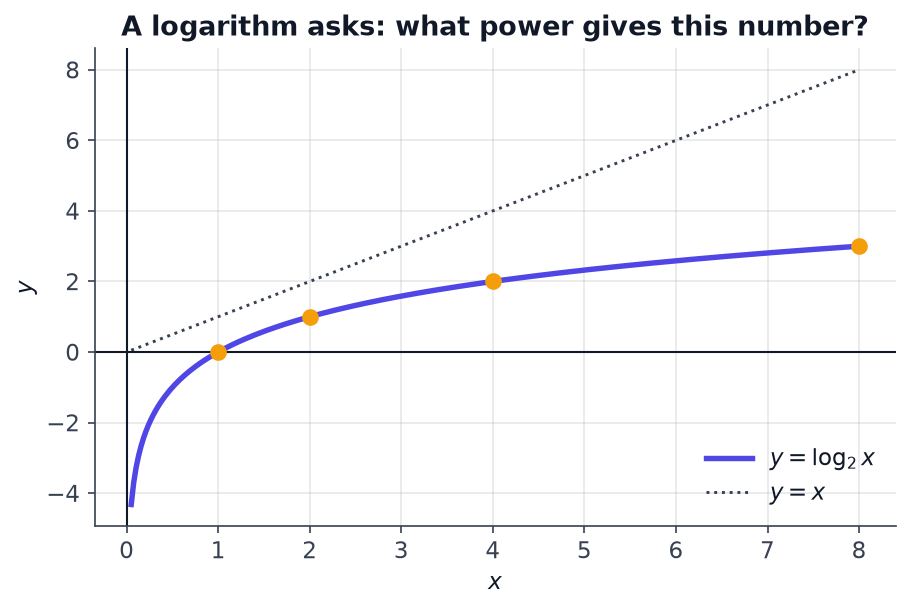
A logarithm answers one specific question: what exponent would I need? If you know that $2^3 = 8$, then the logarithm base $2$ of $8$ is $3$. Written formally, $\log_2 8 = 3$. That single idea — the logarithm as an exponent detector — is the whole concept, and everything else is a consequence of it.
Because logarithms invert exponentiation, they let us solve equations where the unknown sits in the exponent, which ordinary algebra cannot touch.
The Definition
For a positive base $b$ with $b \neq 1$,
The arrow works both ways. From $\log_2 8 = 3$ you recover $2^3 = 8$; from $10^2 = 100$ you recover $\log_{10} 100 = 2$. The requirement that $b > 0$, $b \neq 1$, and $x > 0$ is not optional — logarithms of negative numbers and of zero are undefined in the reals, because no power of a positive base ever reaches them.
Two values are worth memorising. $\log_b 1 = 0$ for every valid base, since $b^0 = 1$. And $\log_b b = 1$, since $b^1 = b$.
The Main Rules
Logarithms turn multiplication into addition. That is their most powerful property:
The third rule follows from the second applied $k$ times, and it is how logarithm tables and slide rules historically did their work.
Two bases appear constantly. Common logarithms use base $10$ and are written $\log x$. Natural logarithms use the irrational base $e \approx 2.71828$ and are written $\ln x$.
Solving Exponential Equations
Suppose $3^x = 40$. Apply a logarithm to both sides:
Applying a logarithm to both sides is legitimate because logarithms are one-to-one functions: if two quantities are equal, their logarithms must be equal as well.
The Change of Base Formula
Calculators normally provide only two logarithm buttons, common and natural. To evaluate any other base you need the change of base rule:
This converts an unfamiliar base into a ratio of familiar ones, which is precisely why calculators can produce $\log_7 25$ at all. For example, $\log_7 25 = \frac{\ln 25}{\ln 7} \approx 1.672$. The formula is also a reminder that a logarithm with a base below $1$ behaves differently, since the ratio of logarithms changes sign.
Worked Example: Solving a Logarithmic Equation
Solve $\log_2(x+3) - \log_2(x-1) = 3$. First combine the two logarithms using the quotient rule, since they share a base:
Now convert the logarithmic statement into its exponential equivalent, which is the definition run backwards:
Multiply through by $x-1$ to get $x + 3 = 8x - 8$, so $11 = 7x$ and $x = \tfrac{11}{7}$. Two checks matter here. Substituting back gives $\log_2(\tfrac{32}{7}) - \log_2(\tfrac{4}{7}) = \log_2 8 = 3$, confirming the answer. Just as importantly, both original arguments must be positive: $x+3$ and $x-1$ are positive when $x = \tfrac{11}{7}$. Had the result been $x = 0$, the logarithms would be undefined and the apparent solution would have to be rejected as extraneous.
Common Mistakes to Watch For
The most damaging error is treating a logarithm as if it distributed over addition. There is no rule for $\log(M + N)$ — that expression stays stuck. Similarly, $\log_b M - \log_b N$ equals $\log_b (M/N)$, never $\log_b (M - N)$.
Another frequent slip is the argument of a logarithm. Writing $\log(-5)$ or $\log 0$ signals a domain error, not a computation to attempt.
Key takeaway: memorise the three rules, keep track of the base, and remember that a logarithm is simply the exponent you are hunting for.
Practice it: try the equation solver or generate a practice set on this topic.