Functions and Their Graphs
A function is a rule that assigns exactly one output to each input. That "exactly one" clause is the whole definition, and it is the reason functions are so useful: given an input, there is never any ambiguity about the answer.
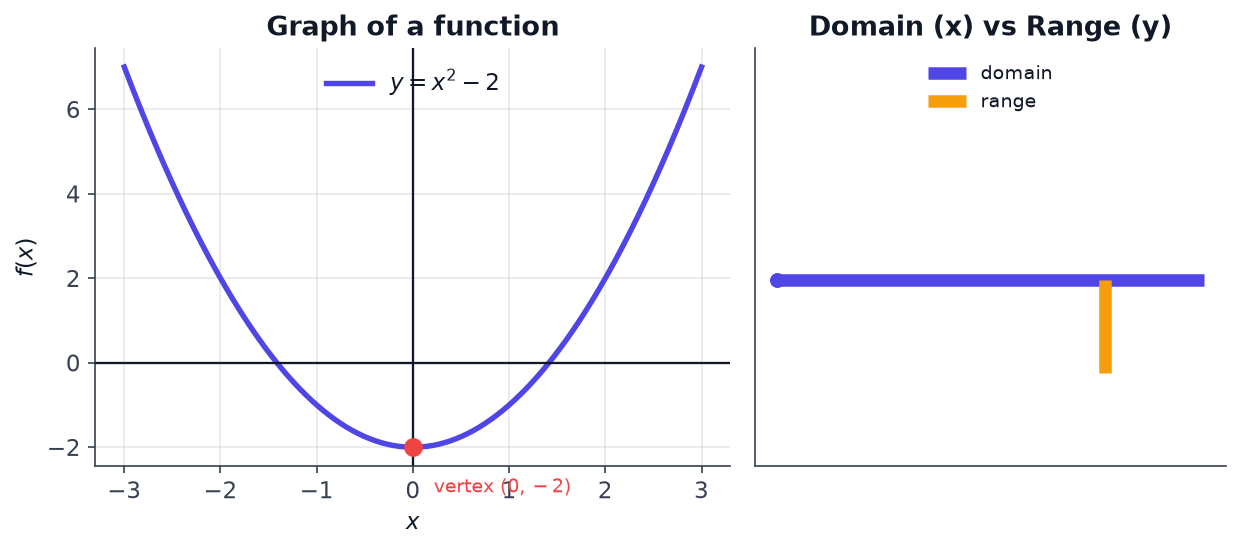
We write $f(x)$ to mean the output of the function $f$ when the input is $x$. For the rule "square the input and subtract two", we would write
and then $f(3) = 3^2 - 2 = 7$. The symbol $f(x)$ is not multiplication; it names the function and its input together.
Domain and Range
The domain is the set of all allowed inputs, and the range is the set of all outputs actually produced. These two sets summarise a function's behaviour and are often the first thing to determine.
For $f(x) = x^2 - 2$, every real number may be squared, so the domain is all reals. But squaring never returns a negative number, so the smallest possible output is $f(0) = -2$, and the range is all reals greater than or equal to $-2$:
Two restrictions on the domain recur constantly. Division by zero is undefined, so any input that makes a denominator zero must be excluded. A square root of a negative number is undefined in the reals, so the expression under a root must be non-negative. These two conditions, applied together, usually pin the domain down completely.
The Vertical Line Test
Not every curve is the graph of a function. The vertical line test settles the question: if any vertical line crosses the curve more than once, that input has several outputs and the curve fails to be a function. A circle fails this test, while a parabola passes it, which is exactly why a parabola can be written as $y = f(x)$ and a circle generally cannot in a single equation.
Key Features of a Graph
Reading a graph fluently means naming its parts. The intercepts are where the curve meets the axes: the $y$-intercept is $f(0)$, found by substituting zero. The vertex of a parabola is its turning point, the lowest or highest value the function attains. Increasing regions rise as you move right, and decreasing regions fall. Symmetry, where present, cuts the work in half, since one side mirrors the other.
A linear function has the form $f(x) = mx + b$ and graphs as a straight line, while a quadratic function has the form $f(x) = ax^2 + bx + c$ and graphs as a parabola. Recognising the family tells you the shape immediately.
Common Mistakes to Watch For
The most common error is confusing domain with range, so keep the phrase "domain runs along $x$" as a reminder. A second slip is treating $f(x + 1)$ as $f(x) + 1$; shifting the input is not the same as shifting the output. Always apply the operation to the whole input, including the added constant.
Key takeaway: fix the domain first, then use the vertical line test, and remember that every input maps to exactly one output.
Practice it: try the equation solver or generate a practice set on this topic.