Sequences and Series
A sequence is an ordered list of numbers, each with a position. A series is what you get when you add the terms of a sequence together. These two ideas appear everywhere, from simple number patterns to the foundations of calculus, where infinite series approximate functions.
The notation is worth learning early. The $n$-th term of a sequence is written $a_n$, and the sum of the first $n$ terms is written $S_n$.
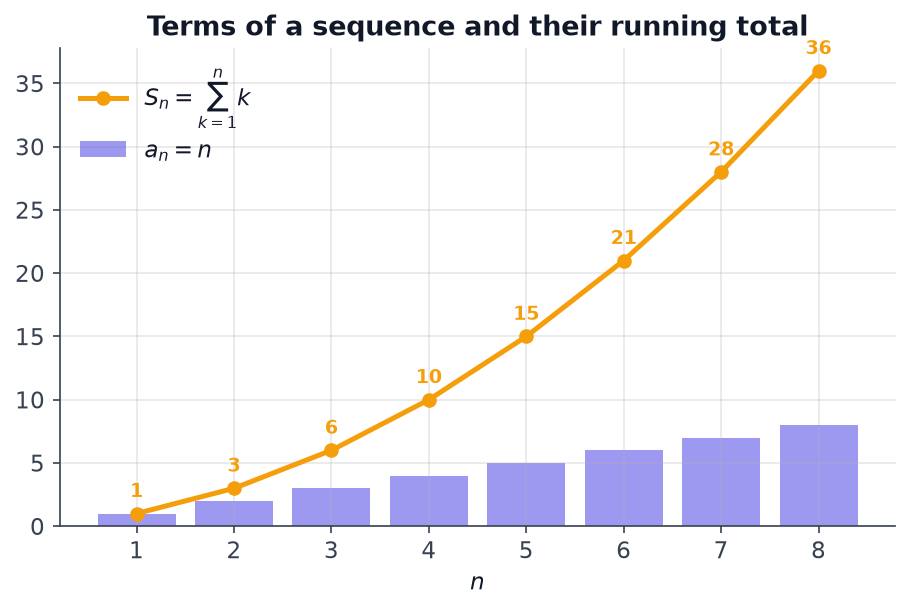
Arithmetic Sequences
An arithmetic sequence adds the same amount each step. That fixed amount is the common difference $d$, and the terms follow
For the sequence $3, 7, 11, 15, \dots$ the common difference is $d = 4$, so the tenth term is
Summing an arithmetic sequence uses a clever pairing trick: the first and last terms average out to a constant. The result is
For the first ten terms above,
Geometric Sequences
A geometric sequence multiplies by the same amount each step. That amount is the common ratio $r$, giving
The sequence $2, 6, 18, 54, \dots$ has $r = 3$, so the fifth term is $a_5 = 2 \times 3^4 = 162$.
When $r \neq 1$, the sum of the first $n$ terms is
and when $|r| < 1$, an infinite geometric series converges to a finite total:
For example, $1 + \frac{1}{2} + \frac{1}{4} + \cdots$ has $a_1 = 1$ and $r = \frac{1}{2}$, so it sums to $2$. The terms never stop, yet the total is finite — a genuinely surprising and important result.
How to Tell Them Apart
Look at the gaps between consecutive terms. If the differences are constant, the sequence is arithmetic; use the linear formula. If the ratios are constant, it is geometric; use the exponential formula. When neither holds, the sequence may follow a polynomial or recursive rule, and you would compute terms directly.
Sigma Notation
Writing out long sums quickly becomes unwieldy, so mathematicians compress them with the capital sigma symbol $\Sigma$. The expression
reads as "add the terms $a_k$ as $k$ runs from $1$ to $n$". The letter $k$ is called the index, and it is a dummy variable: renaming it to $i$ or $j$ changes nothing. For example,
Sigma notation is compact, unambiguous, and essential once you meet the formulas for arithmetic and geometric sums again in calculus, where it becomes the foundation for integrals. Learning to translate between the expanded list and the sigma form is mostly a matter of practice, and it pays off every time you need to reason about a sum without adding every term by hand.
Common Mistakes to Watch For
The most common error is applying the arithmetic formula to a geometric sequence, or the reverse. A second slip is the off-by-one in the exponent: the $n$-th term uses $n - 1$ steps from the first term, not $n$. Watch also for the convergence condition, because the infinite-sum formula only works when $|r| < 1$; applying it when $r = 2$ produces a negative total that is meaningless.
Key takeaway: identify whether terms grow by addition or multiplication, then choose the matching formula and double-check the index.
Practice it: try the equation solver or generate a practice set on this topic.