Definite Integrals and Area
A definite integral has two endpoints and produces a single number. That number is the signed area between the curve and the horizontal axis, from the left endpoint to the right one. Understanding the word "signed" is the key to using definite integrals correctly.
Signed Area
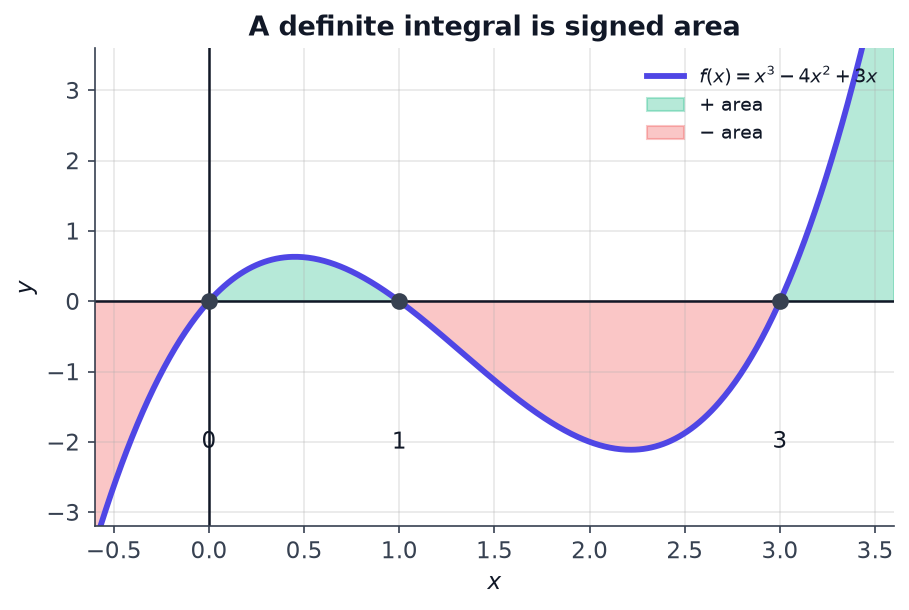
Area above the axis counts as positive, and area below the axis counts as negative. When a curve crosses the axis, the integral adds the parts together with their signs, so cancellation can occur. In the figure, the curve rises above the axis, dips below, and rises again, and the integral sums all three contributions into one net value.
This is not a flaw; it is exactly what makes the integral useful. If the curve describes the velocity of a car moving forward and then backward, the signed integral gives its net displacement — where it ended up. The total distance travelled, ignoring direction, would instead come from integrating the absolute value $|v(t)|$.
For the function $f(x) = x^{3} - 4x^{2} + 3x$, which crosses zero at $x = 0$, $x = 1$, and $x = 3$,
adds a positive region on the first interval and a negative region on the second, producing a modest net result even though the two areas are individually sizable.
Evaluating a Definite Integral
The procedure comes straight from the fundamental theorem:
- Find an antiderivative $F$ of the integrand.
- Evaluate $F$ at the upper limit.
- Subtract $F$ at the lower limit.
Worked example. Compute $\displaystyle\int_{1}^{4} 2x\, dx$. An antiderivative of $2x$ is $x^{2}$, so
The region is a trapezoid, and calculating it with the trapezoid area formula confirms the value: $\frac{1}{2}(2 + 8)(3) = 15$. Geometry and calculus agree, as they must.
Total Area Versus Net Area
When a problem asks for the total area enclosed between a curve and the axis, you must split the interval at every zero crossing and integrate the pieces separately, taking the absolute value of each. Integrating straight across gives the net signed value, which is usually smaller, and using it where total area was wanted is a very common source of lost marks.
Properties Worth Knowing
The definite integral behaves predictably. Reversing the limits changes the sign:
Splitting an interval at an interior point preserves the total:
And an integral from a point to itself is always zero, because there is no width to accumulate over.
Common Mistakes to Watch For
Watch for negative answers when a physical quantity such as area or distance should be positive — that signals a missing absolute value or a forgotten sign. Also remember to find all the zeros of the integrand before splitting, not just the obvious ones, or a hidden crossing will corrupt the total.
Key takeaway: a definite integral is signed area, so decide first whether you want the net value or the total, and split at every zero crossing when the total is required.
Practice it: try the equation solver or generate a practice set on this topic.