Derivatives: Rules and Meaning
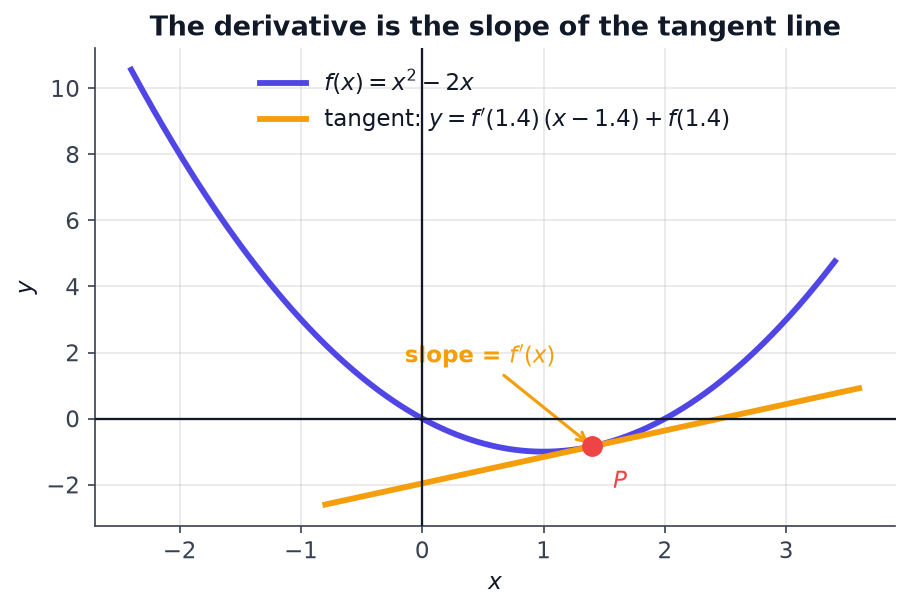
The derivative is the central idea of differential calculus. At heart it measures a rate of change — how fast one quantity responds when another changes. Geometrically, the derivative at a point is the slope of the tangent line to the curve at that point.
That picture is worth holding onto. The steepness of a hill, the speed shown on a car's dashboard, and the growth rate of a population are all derivatives in disguise.
The Definition
The derivative is built from a limit of slopes between two nearby points:
The fraction inside is the slope of a secant line joining two points a distance $h$ apart. As $h$ shrinks toward zero, the secant line rotates into the tangent line, and its slope becomes the derivative. This single limit, applied carefully, is where every rule below comes from.
The Power Rule and Its Friends
Rather than apply the limit every time, we use shortcuts. The power rule handles ordinary powers:
so the derivative of $x^{3}$ is $3x^{2}$, and the derivative of $x$ is $1$. Constants have zero derivative, because a flat line has no slope.
Two more combine functions. The sum rule lets you differentiate term by term:
and the constant multiple rule pulls numbers out front:
Together they differentiate any polynomial in seconds.
A Worked Example
Differentiate $f(x) = x^{3} - 5x^{2} + 7$. Apply the power rule to each term separately:
To find the slope at a specific point, substitute. At $x = 2$,
The negative sign says the curve is falling at that point, so the tangent line slopes downward.
Velocity as a Derivative
The most intuitive application is motion. If $s(t)$ is the position of an object at time $t$, then its velocity is the derivative $v(t) = s'(t)$, and its acceleration is the second derivative $a(t) = s''(t)$. For a falling ball with position $s(t) = 5t^{2}$, the velocity is $10t$, so after two seconds the ball is falling at $20$ units per second. The algebra of derivatives becomes a description of physical motion.
Higher Derivatives
Differentiating a derivative produces the second derivative, written $f''(x)$ or, in Leibniz notation, $\frac{d^{2}y}{dx^{2}}$. The second derivative describes how the slope itself is changing, which is exactly what curvature and concavity mean.
Worked example. For $f(x) = x^{3} - 5x^{2} + 7$, the first derivative is $f'(x) = 3x^{2} - 10x$. Differentiating again gives
At $x = 0$ this is $-10$, meaning the slope is decreasing there and the curve bends downward. In physics the second derivative carries direct meaning: if position is $s(t)$, the first derivative is velocity and the second is acceleration. A car that speeds up has positive acceleration, so its velocity is an increasing function — a statement about a second derivative. This pattern continues, but beyond the second derivative the physical intuition thins out while the algebra stays identical.
Common Mistakes to Watch For
The most frequent error is forgetting to reduce the exponent by one, or dropping the original exponent entirely. Another is misapplying the power rule to a constant: the derivative of $7$ is $0$, not $7$. A third slip is treating $f(x + h)$ as $f(x) + h$ in the definition; the whole input must be substituted.
Key takeaway: the derivative is a slope and a rate at the same time, and the power, sum, and constant rules handle every polynomial.
Practice it: try the equation solver or generate a practice set on this topic.