The Fundamental Theorem of Calculus
The fundamental theorem is the bridge that joins the two halves of calculus. Differentiation and integration look like separate subjects, one about rates and one about accumulation, and the theorem reveals that they are inverse operations. This is arguably the single most important result in the entire subject.
The Two Halves
The theorem has two parts. The first says that if you start with a continuous function $f$ and define a new function by accumulating its area,
then that accumulation function is differentiable, and its derivative is the original function:
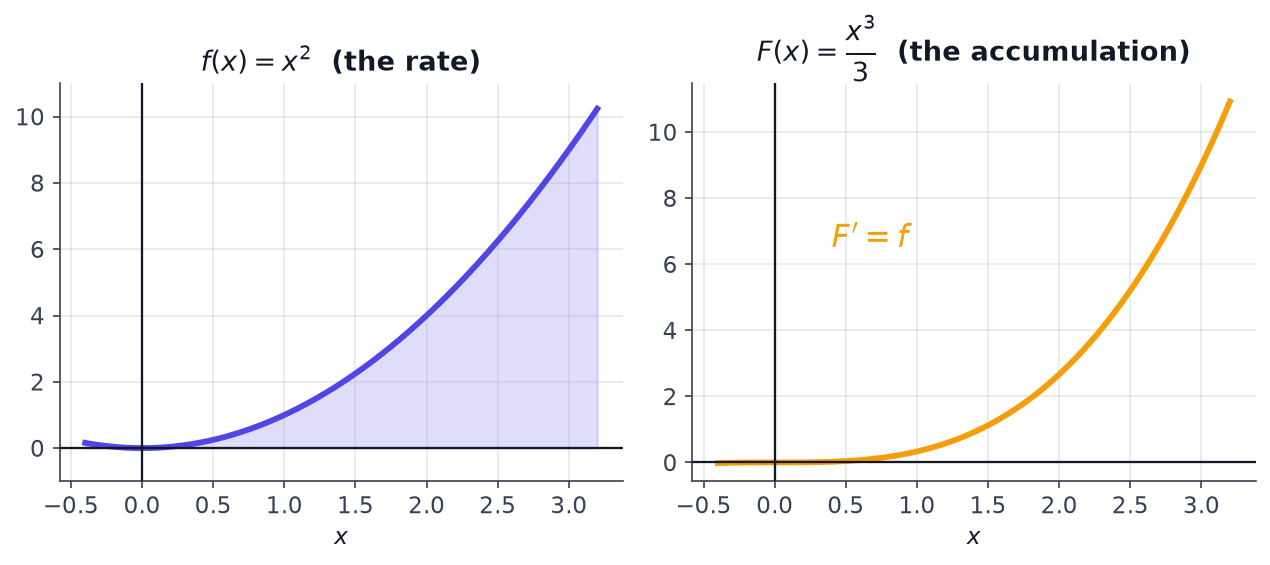
Accumulating and then differentiating brings you right back. The rate of growth of the accumulated area is simply the height of the curve.
The second part turns this into a computational tool. If $F$ is any antiderivative of $f$, then the definite integral is
The figure makes the relationship visible: on the left the function $f(x) = x^{2}$ gives the rate, and on the right its antiderivative $F(x) = \frac{x^{3}}{3}$ gives the total accumulation. Where $f$ is large, $F$ rises quickly; where $f$ is small, $F$ flattens out.
Using It to Compute an Integral
The theorem replaces the tedious process of adding up infinitely many rectangles with a simple evaluation.
Worked example. Compute
An antiderivative of $x^2$ is $F(x) = \frac{x^{3}}{3}$. Evaluate it at the endpoints and subtract:
The area under the parabola from $0$ to $3$ is exactly $9$ square units. Doing this by summing rectangles would take enormous effort; the theorem turns it into two substitutions.
A Second Worked Example
The theorem handles more than polynomials. Consider
An antiderivative of $\frac{1}{x}$ is $\ln|x|$, which is positive throughout the interval, so the absolute value bars are unnecessary here. Evaluating at the endpoints gives
This single result is remarkable: the area under the curve $y = \frac{1}{x}$ from $1$ to $2$ equals the natural logarithm of $2$. That equality is, in fact, sometimes used as the very definition of the natural logarithm, which shows how tightly the theorem binds together algebra, geometry, and the special number $e$.
Why It Works
The intuition is worth holding on to. As $x$ increases by a tiny amount, the accumulated area grows by a thin strip of height $f(x)$. Dividing that increase in area by the small change in $x$ gives a value close to $f(x)$, and taking the limit makes it exact. That is precisely the statement $F'(x) = f(x)$. The theorem is not a lucky coincidence; it is the inevitable consequence of how area accumulates.
The Notation
The vertical bar notation compresses the second part:
The constant $C$ does not matter here, because it appears in both $F(b)$ and $F(a)$ and cancels in the subtraction. That is why definite integrals never carry a $+C$.
Common Mistakes to Watch For
The most common error is subtracting in the wrong order, computing $F(a) - F(b)$ instead of $F(b) - F(a)$, which flips the sign. A second mistake is forgetting that the integrand must be the derivative of $F$; check the antiderivative by differentiating before evaluating. A third is dropping a constant incorrectly, though for definite integrals this harmlessly cancels.
Key takeaway: differentiation and integration undo each other, and the theorem lets you evaluate any area by subtracting two antiderivative values.
Practice it: try the equation solver or generate a practice set on this topic.