Systems of Linear Equations
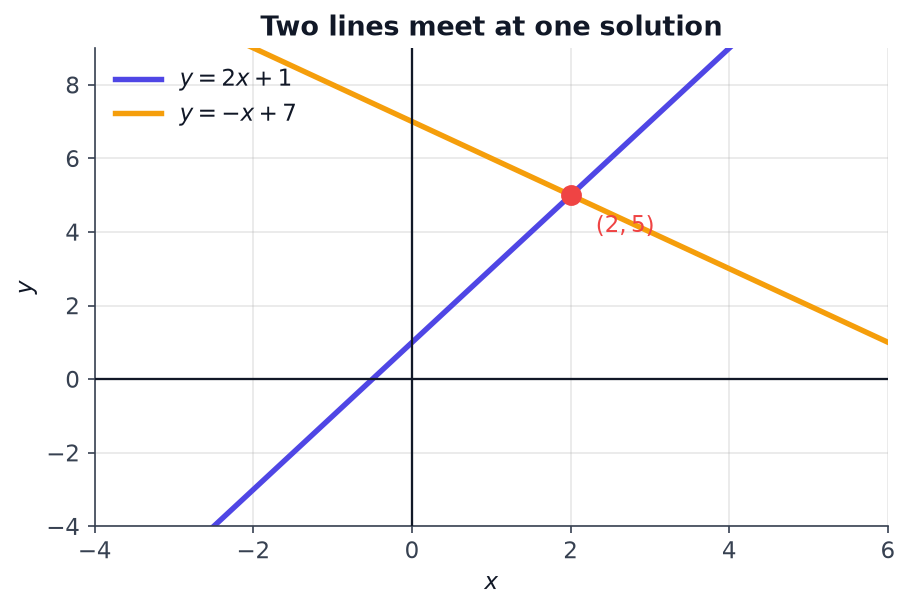
A single linear equation like $2x + 1 = y$ has infinitely many solutions — every point on its line works. A system of linear equations asks a harder question: which point satisfies all the equations at once? Geometrically, that point is where the lines cross. Algebraically, we want one ordered pair $(x, y)$ that makes every equation true simultaneously.
A linear equation in two variables always graphs as a straight line, so the whole problem becomes a question about how two lines can meet. There are exactly three possibilities, and being able to recognise which one you have is the first real skill here.
The Three Possible Outcomes
If two lines have different slopes, they intersect in exactly one point. That system is consistent and independent, and it has a single unique solution. If the two equations describe the same line, every point on that line is a solution, giving infinitely many. This happens when one equation is just a constant multiple of the other, so the system is dependent. Finally, if the lines are parallel they never meet, and the system is inconsistent — it has no solution at all.
You can often tell these apart by rewriting each equation in slope-intercept form $y = mx + b$. Matching slopes with different intercepts means parallel lines. Identical slopes and identical intercepts mean the same line.
Method 1: Substitution
Substitution works best when one variable is already isolated or easy to isolate. Take the system
Since the first equation already gives $y$, substitute it into the second:
Then back-substitute to find $y = 2 \cdot \frac{11}{5} + 1 = \frac{27}{5}$.
Method 2: Elimination
Elimination is usually faster when the coefficients line up. Multiply equations as needed so that adding or subtracting them cancels a variable. For
the $y$ terms already have opposite coefficients, so adding the two equations gives $6x = 24$, hence $x = 4$. Substituting back yields $y = 8/3$.
Which Method Should You Choose?
Neither method is universally better, so read the system before starting. Choose substitution when a variable already stands alone or has a coefficient of $1$, because isolating it costs no division. Choose elimination when the coefficients are constant multiples of each other, since one addition or subtraction then removes a variable immediately. If neither condition holds, elimination with a small scaling step is usually cleaner than forcing substitution to produce awkward fractions.
There is also a useful third path for quick checks. Multiply each equation through so the variables have matching coefficients, then compare. When two equations reduce to the identical statement, the lines coincide and the system has infinitely many solutions. When they reduce to a contradiction such as $0 = 5$, the lines are parallel and no solution exists.
A real-world system often arrives in words rather than symbols, so the first move is translation. Define what each unknown represents, write one equation per condition, and only then decide which method applies. Skipping the translation step is where most word-problem errors begin, long before any arithmetic takes place.
Common Mistakes to Watch For
The most frequent error is an arithmetic slip during elimination — forgetting to distribute a negative sign when subtracting an entire equation. A second trap is declaring "no solution" too quickly when the variables merely look messy. Always reduce to the form $0 = c$. If $c$ is a nonzero number, the system truly has no solution. If you get $0 = 0$, the system has infinitely many solutions. That single line of reasoning separates parallel lines from identical lines every time.
Key takeaway: rewrite, eliminate, and check your result by substituting the pair back into both original equations. A solution that only satisfies one equation is not a solution to the system.
Practice it: try the equation solver or generate a practice set on this topic.