Integration Basics
Integration reverses differentiation. If a derivative answers "how fast is this changing", an integral answers "how much has accumulated". The two operations are inverse in the same way that squaring and taking a square root are inverse.
Geometrically, the integral measures area under a curve. That interpretation is the reason integration solves problems about totals: total distance from a velocity, total cost from a rate, total growth from a rate of change.
The Antiderivative
An antiderivative of $f$ is any function $F$ whose derivative is $f$:
The basic tool mirrors the power rule, running it backwards. To integrate a power, raise the exponent by one and divide by the new exponent, so long as the exponent is not $-1$:
The symbol $\int$ is a stretched letter S, standing for "sum". For example,
Check it by differentiating: the derivative of $\frac{x^3}{3}$ is indeed $x^2$.
Why the Constant Appears
The $+C$ is not decoration. Because the derivative of any constant is zero, infinitely many functions share the same derivative — $x^2$, $x^2 + 7$, and $x^2 - 40$ all differentiate to $2x$. So the antiderivative is only determined up to an unknown constant. This is why integration without limits is called an indefinite integral, and why it is written as a family of functions rather than a single one.
Building Up More Integrals
Just as differentiation had a sum rule that worked term by term, so does integration:
and constants pull straight out:
Worked example. Find $\displaystyle\int \left(3x^{2} + 4x\right) dx$. Integrate each term:
Differentiating the answer returns $3x^2 + 4x$, confirming the work.
The Rectangle Picture
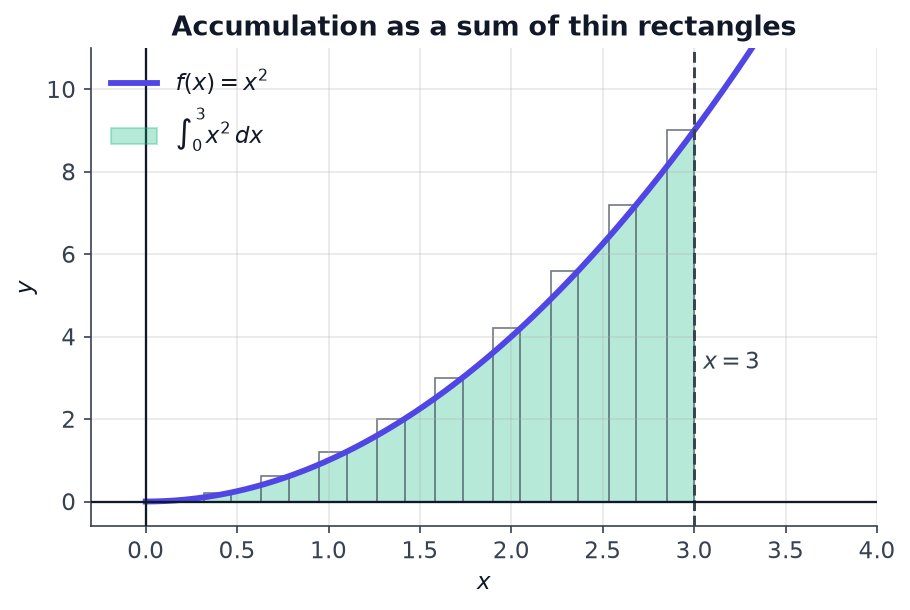
Why does integration compute area? Slice the region under a curve into many thin vertical rectangles. Each rectangle has height $f(x)$ and a tiny width $dx$, so its area is $f(x)\, dx$. Adding all the strips and letting the width shrink toward zero is exactly what the integral symbol does. The figure shows the rectangles filling the area more tightly as they multiply. That limit of a sum is also why $\int$ and $\sum$ look so similar.
A Short Table of Integrals
Most early work draws on a handful of standard results. Keeping them together saves time and reduces errors:
Each entry can be verified by differentiating the right-hand side, which is the best way to commit the table to memory. Notice that the direction of both signs deserves attention: the integral of cosine is positive sine, while the integral of sine carries a minus sign. Reversing an entry is a common slip, so the habit of differentiating the answer back is genuinely valuable rather than merely cautious. The logarithmic case stands apart from the power rule precisely because its exponent is $-1$, the one value the general formula cannot handle.
Common Mistakes to Watch For
The classic error is forgetting the $+C$ on an indefinite integral, which loses a whole family of solutions. A second slip is dividing by the original exponent instead of the new one. A third is trying to integrate $\frac{1}{x}$ with the power rule, which fails because the exponent is $-1$; that case has its own answer, $\ln|x| + C$.
Key takeaway: integration undoes differentiation, every indefinite integral carries a $+C$, and the whole operation is a carefully refined area of addition.
Practice it: try the equation solver or generate a practice set on this topic.