Limits and Continuity
Calculus rests on one idea: what happens to a function as its input creeps toward a particular value? That is the limit. It is the bridge between ordinary algebra and the two great tools of calculus, the derivative and the integral.
The limit asks a deliberately delicate question. It does not ask the value of the function at a point, but the value it approaches as we get arbitrarily close. The difference matters precisely where a function behaves strangely.
The Intuitive Definition
We write
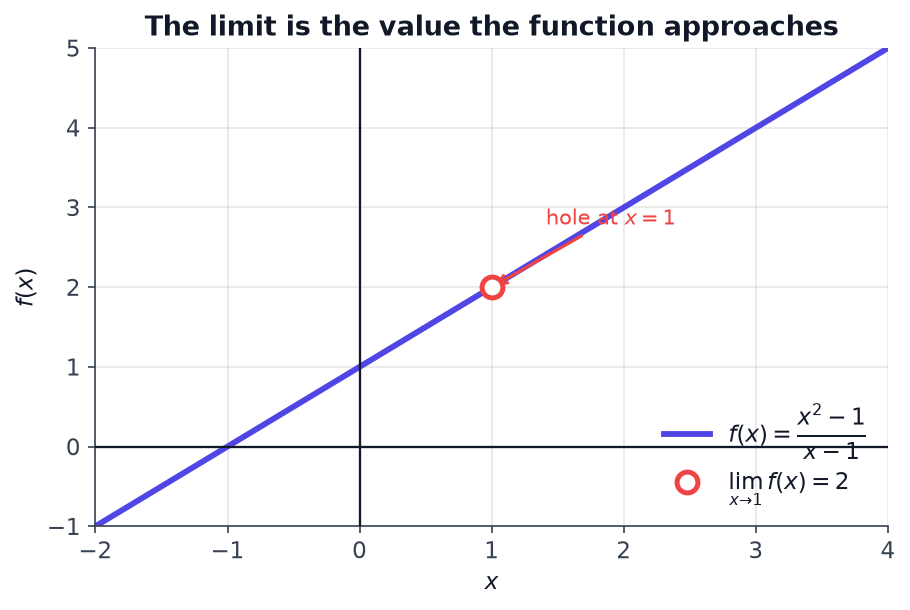
to mean that as $x$ gets closer and closer to $a$, the outputs $f(x)$ get closer and closer to $L$. Crucially, the function need not even be defined at $a$. In the figure, the function simplifies to a straight line except for a single missing point, yet the limit there is perfectly well defined.
Evaluating Limits Directly
For well-behaved functions, substitution is all you need:
When substitution produces $\frac{0}{0}$, that is not a final answer; it is a signal that algebra is required. Worked example. Evaluate
Direct substitution gives $\frac{0}{0}$. Factor the numerator as a difference of squares:
The cancellation is legal everywhere except at $x = 1$, which is exactly where we are taking the limit. The simplified expression makes the answer obvious:
So the limit is $2$, even though the original function had a hole at that point.
One-Sided Limits and Continuity
Sometimes a function approaches different values from the left and the right. We write $x \to a^-$ for approach from below and $x \to a^+$ from above. The two-sided limit exists only when both one-sided limits agree.
That leads to continuity. A function is continuous at a point when three conditions hold at once: the function is defined there, the limit exists there, and the two are equal,
A useful picture emerges: a continuous function is one you can draw without lifting your pen. At a jump, a hole, or a vertical asymptote, continuity fails and the limit tells you exactly how.
Limits at Infinity
The idea of a limit also describes long-term behaviour, asking what happens as $x$ grows without bound. Writing $x \to \infty$ means the input becomes arbitrarily large. The classic example is
As the denominator grows, the fraction shrinks toward zero without ever reaching it. This is not an approximation to be dismissed; the limit is exactly zero. The same reasoning gives $\lim_{x \to \infty} \frac{1}{x^2} = 0$ and, more generally, any expression of the form $\frac{1}{x^n}$ with $n > 0$.
These limits describe horizontal asymptotes, the values a curve settles toward far out on the graph. For a rational function, comparing the degree of the numerator with the degree of the denominator tells you the answer quickly: a lower-degree numerator gives a limit of zero, equal degrees give the ratio of leading coefficients, and a higher-degree numerator means no finite limit exists. This single comparison replaces a good deal of guesswork when sketching unfamiliar functions.
Common Mistakes to Watch For
The most common error is stopping at $\frac{0}{0}$ and declaring the limit undefined; it means indeterminate, so simplify first. A second mistake is assuming the limit equals the function value, which fails whenever there is a hole. A third is being careless about which side you approach from, especially near a piecewise definition.
Key takeaway: a limit describes approaching, not arriving, and an indeterminate form is an invitation to do more algebra.
Practice it: try the equation solver or generate a practice set on this topic.