Angles and Parallel Lines
When two parallel lines are cut by a third line, a surprisingly large number of angle relationships appear at once. Understanding those relationships lets you find an unknown angle without measuring anything — pure reasoning, guided by a small set of rules. This guide collects the rules and shows how they fit together.
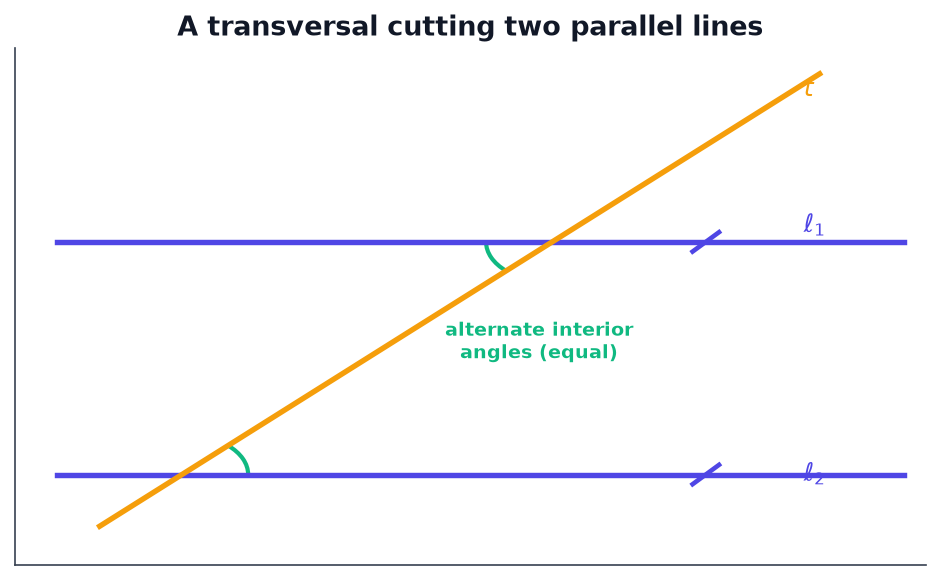
The third line that crosses the two parallels is called a transversal. Every angle it creates can be paired with another angle somewhere else in the diagram, and those pairs have names that tell you exactly how the measures relate.
The Angle Pairs
When two lines are parallel, the following pairs are congruent, meaning they have equal measure:
- Corresponding angles occupy the same relative position at each intersection. For example, the angle above the upper line and to the right of the transversal corresponds to the angle above the lower line and to the right of the transversal.
- Alternate interior angles sit between the parallels on opposite sides of the transversal. They are equal.
- Alternate exterior angles sit outside the parallels on opposite sides. They are also equal.
One further relationship is special. Consecutive interior angles (also called co-interior angles) lie between the parallels on the same side of the transversal. Instead of being equal, they are supplementary:
That difference is a frequent source of errors. Corresponding and alternate pairs are equal; co-interior pairs add to a straight angle.
A Worked Example
Suppose the interior angle below the upper line and to the left of the transversal is $68^{\circ}$. Find the interior angle above the lower line and on the same side of the transversal. The corresponding angle at the lower intersection is also $68^{\circ}$; it lies below the lower line, and the required interior angle forms a linear pair with it, so
Alternatively, go directly through co-interior angles and write $x + 68^{\circ} = 180^{\circ}$. Both routes give $112^{\circ}$, which is a good sign — different paths in geometry should converge on the same answer.
How to Use the Diagram
Always mark the given information on the figure first, then trace a chain from the known angle to the unknown one. One useful shortcut: if you can find any angle at the second intersection, every other angle there follows from the fact that angles around a point total $360^{\circ}$ and angles on a straight line total $180^{\circ}$.
Common Mistakes to Watch For
The most common error is assuming two lines are parallel when the problem never said so. These relationships are not guaranteed for non-parallel lines; if parallelism is not stated or marked, do not assume it. A second slip is mixing up equal pairs with supplementary pairs. Use the positions of the angles and the stated parallel lines, not how the drawing happens to look, to decide which relationship applies.
Key takeaway: memorise the three equal pairs and the one supplementary pair, and always confirm the lines really are parallel before applying them.
Practice it: try the equation solver or generate a practice set on this topic.