Area and Perimeter of Polygons
Perimeter and area measure two different things. Perimeter is the distance right around the outside of a shape, so it is a length. Area is the amount of surface the shape covers, so it is measured in square units. Confusing the two is the most common early mistake, and it is worth fixing before moving on.
A polygon is a closed shape made entirely from straight line segments. Triangles, rectangles, parallelograms, trapezoids, and regular hexagons are all polygons, and each has its own pair of formulas.
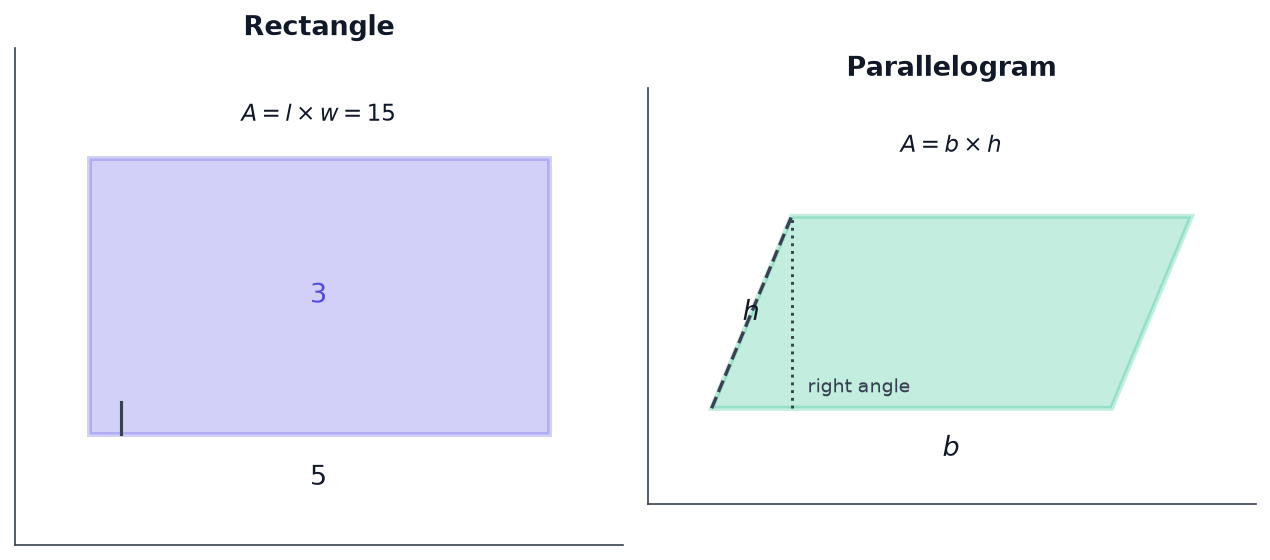
Triangles and Rectangles
Every polygon can be sliced into triangles, which makes the triangle the foundation of the whole subject. Its area is
where $b$ is any side and $h$ is the perpendicular height dropped to that side. The height must be perpendicular, not slanted — using a slanted edge as the height is a frequent error.
A rectangle is a quadrilateral with four right angles, so its opposite sides are equal:
A square is the special case where $l = w$, giving $P = 4s$ and $A = s^2$.
Parallelograms and Trapezoids
A parallelogram has two pairs of parallel sides. Its area looks like a rectangle that has been pushed sideways:
where $h$ is again the perpendicular height, not the slanted side length. Cutting the triangular overhang from one side and sliding it across rebuilds the shape as a rectangle of the same base and height, which is why the formula holds.
A trapezoid has exactly one pair of parallel sides, called the bases $b_1$ and $b_2$:
The area is the average of the two bases multiplied by the height.
Worked example. A trapezoid has bases $8$ cm and $12$ cm with a perpendicular height of $5$ cm.
Its perimeter, however, needs all four side lengths. If the slanted sides are each $6$ cm, then
Notice the units: $50 \text{ cm}^2$ for area but $32 \text{ cm}$ for perimeter. Dimensional sanity checks like that catch many errors.
Regular Polygons
A regular polygon has all sides equal and all angles equal. If it has $n$ sides of length $s$, the perimeter is simply
Apothems and central angles give the area, but for most school work you will instead divide the shape into congruent isosceles triangles.
Composite Shapes
Real floor plans and garden layouts are rarely a single tidy rectangle, so the most practical skill in this topic is splitting an awkward shape into familiar ones. Cut the figure along a straight line into two rectangles or triangles, work out each area separately, and add the results. The reverse trick handles shapes with a piece missing: compute the area of the full outer figure as though the gap were filled, then subtract the gap.
The perimeter rule is different and easy to get wrong. When you slice a shape in two, you create new interior edges that are not part of the boundary, so the perimeters of the pieces do not simply add to the perimeter of the whole. Perimeter must be measured by walking around the outside only, counting each exterior edge once.
A useful discipline is to label every segment as you go, because a missing side length is the usual reason a composite problem stalls halfway through.
Common Mistakes to Watch For
The classic error is using a slanted side where a perpendicular height is required. A second slip is reaching for the perimeter formula when asked for area, or the reverse. Always read the question twice and check the units: centimetres indicate perimeter, square centimetres indicate area.
Key takeaway: identify the shape, confirm which measurement is being asked for, and make sure every height you use is perpendicular to its base.
Practice it: try the equation solver or generate a practice set on this topic.