Circles: Area and Circumference
A circle is the set of all points that are the same distance from a centre point. That single defining property is enough to produce the two formulas every student needs: one for the distance around the circle, and one for the space inside it.
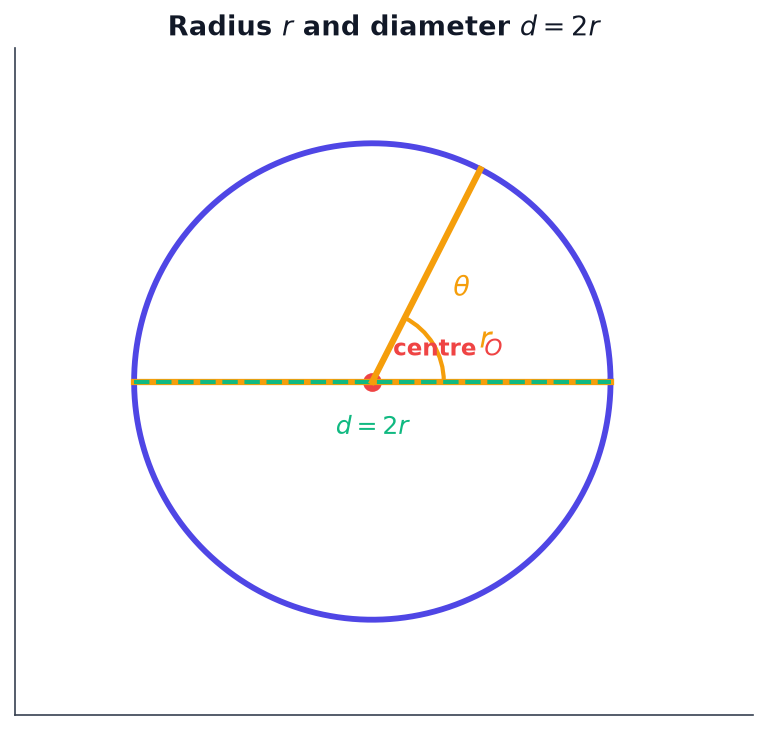
The distance from the centre to any point on the circle is the radius, written $r$. The diameter $d$ is the distance across the circle through the centre, so it is exactly twice the radius:
Circumference
The distance around a circle is its circumference. The famous formula relates it to a special constant $\pi$:
The number $\pi$ is approximately $3.14159$, and it appears whenever circles appear. It is irrational, so its decimal expansion never repeats and never terminates — which means an exact answer must be left in terms of $\pi$.
Worked example. A wheel has radius $21$ cm. Its circumference is
Both forms are legitimate, but they suit different purposes. The exact form $42\pi$ is preferred in algebra, while the decimal approximation is what you need when ordering material or converting to another unit.
Area
The area of a circle is
The exponent of $2$ is worth reflecting on. Area is always measured in square units, and squaring the radius is what produces those square units. A common error is writing $\pi r^{2}$ as $\pi (2r)^{2} = 4\pi r^{2}$ by squaring the diameter instead of the radius.
Worked example. For a circle with radius $7$ m,
Sectors
A slice of the circle is a sector. Since a full circle is $360^{\circ}$, a sector with central angle $\theta$ is the fraction $\theta/360$ of the whole:
and its arc length is the same fraction of the circumference:
Working Backwards
Formulas are often needed in reverse. If you know the circumference, isolate $r$ before substituting:
Worked example. A circular garden border measures $31.4$ m around. Taking $\pi \approx 3.14$ gives
The same reversal applies to area:
Note the order here: divide by $\pi$ first, then take the square root. Square-rooting before dividing is a frequent algebra slip and produces a noticeably wrong radius. Working backwards like this appears constantly in design and engineering problems, where a known target size must be converted into the dimensions that achieve it.
Common Mistakes to Watch For
The single most common error is confusing radius with diameter. If a problem gives the diameter, halve it before substituting, or the answer will be far too large. A second slip is forgetting to square when finding area, which produces a result in the wrong units — a strong signal that something went wrong. Watch also for unit consistency: if the radius is in centimetres, the area comes out in square centimetres, and mixing it with a radius in metres produces nonsense.
Key takeaway: decide whether you need distance around (circumference) or space inside (area), confirm you are using the radius, and leave exact answers in terms of $\pi$ unless a decimal is asked for.
Practice it: try the equation solver or generate a practice set on this topic.