Triangles and the Pythagorean Theorem
Triangles are the simplest polygons, and every polygon can be broken into them, which is why so much of geometry is really triangle geometry. The most famous result about triangles is the Pythagorean theorem, which links the three side lengths of a right triangle in a single equation.
A right triangle contains one angle of exactly $90^{\circ}$. The side opposite that angle is called the hypotenuse, and it is always the longest side. The other two sides are the legs.
The Theorem
For a right triangle with legs $a$ and $b$ and hypotenuse $c$,
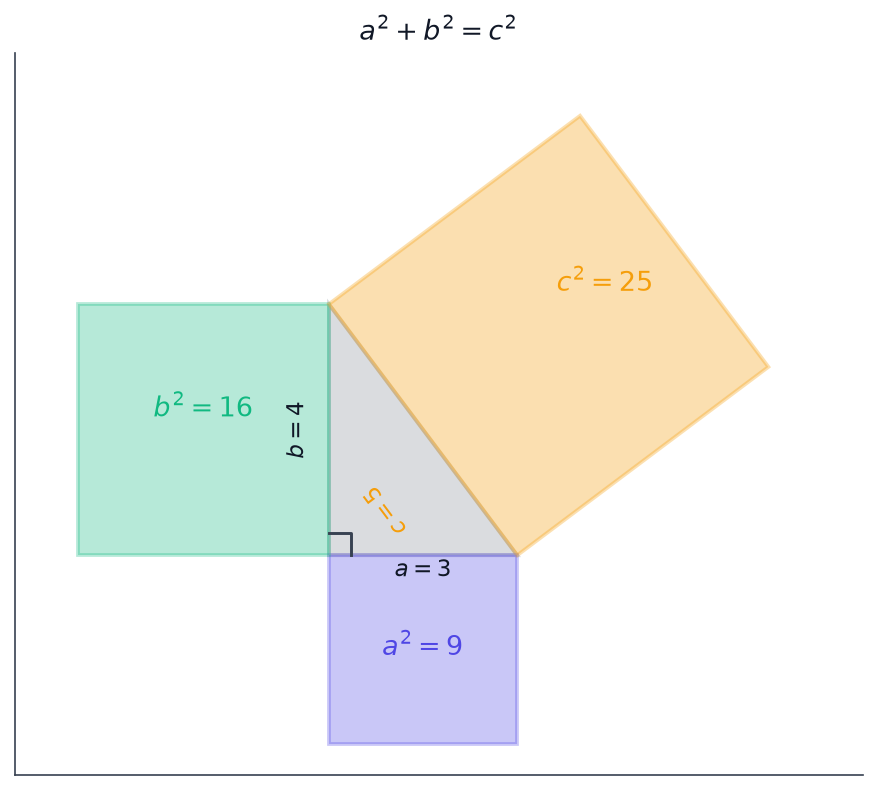
The figure shows why this is believable. A square built on each side has area equal to the square of that side's length, and the two smaller squares together have exactly the same area as the largest one. For the triangle $3$, $4$, $5$ this reads $9 + 16 = 25$, which checks out.
The converse works too: if $a^2 + b^2 = c^2$ holds for three side lengths, the triangle is right. This is how builders verify a corner is square using the $3$-$4$-$5$ rule.
Using It Correctly
Worked example. A ladder leans against a wall with its foot $6$ feet from the base, reaching a point $8$ feet up the wall. How long is the ladder? The wall and ground meet at a right angle, so the ladder is the hypotenuse:
The ladder is $10$ feet long. Notice that you square the given sides, add, then take the square root. The order matters: forgetting to add before the root is the classic failure.
Worked example with a missing leg. If the hypotenuse is $13$ and one leg is $5$,
When the unknown is a leg, you subtract rather than add. That is the whole trick: the theorem always isolates the longest side on one side of the equals sign.
Special Right Triangles
Certain triples recur so often they are worth memorising: $(3,4,5)$, $(5,12,13)$, $(8,15,17)$, and $(7,24,25)$. Any multiple of a triple works as well, so $(6,8,10)$ is also right. These let you skip the arithmetic entirely on standardised problems.
Area of a Right Triangle
The theorem also connects to area. Any triangle has area equal to half its base times its perpendicular height, and in a right triangle the two legs serve directly as base and height:
For the $3$-$4$-$5$ triangle this gives $A = \tfrac{1}{2} \times 3 \times 4 = 6$ square units. Combining this with the theorem lets you solve layered problems: given the hypotenuse and one leg, find the missing leg first, then use both legs for the area. That two-step pattern is extremely common, so it is worth practising until it feels automatic.
Common Mistakes to Watch For
The most frequent error is applying the theorem to a triangle that is not right-angled. It holds only for right triangles; in any other triangle the relationship is an inequality. A second mistake is using the hypotenuse as one of the legs when it is actually known, which leads to adding when you should subtract. Always identify the right angle first, then name the hypotenuse before writing anything down.
Key takeaway: label the hypotenuse before you compute, square both known sides, and remember that the unknown leg means subtraction.
Practice it: try the equation solver or generate a practice set on this topic.