Similarity and Congruence
Two shapes can look alike without being the same size. Geometry separates these ideas carefully: congruent figures are identical in every respect, while similar figures have the same shape but may differ in size.
Formally, congruent figures have equal corresponding side lengths and equal corresponding angles. Similar figures have equal corresponding angles but their side lengths differ by a common scale factor $k$.
The Scale Factor
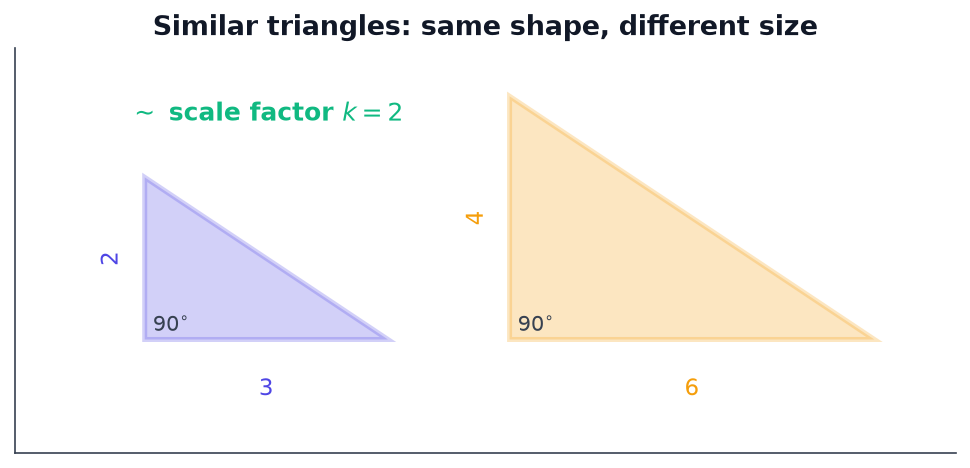
If every side of one figure is $k$ times the corresponding side of another, the figures are similar with scale factor $k$. In the figure the smaller triangle has legs $2$ and $3$, while the larger has $4$ and $6$, so
Angles are untouched by scaling. Rotating or resizing a shape never changes its angles, which is precisely why equal angles are the test for similarity in the first place.
The relationship between areas and scale factors surprises people: area grows with the square of $k$.
Since $k = 2$ here, the larger triangle has four times the area of the smaller one. For volumes the factor is cubed.
Testing Triangles for Similarity
Three shortcuts avoid measuring every side:
- AA (Angle-Angle): two pairs of equal angles are enough, because the third pair must match automatically.
- SSS (Side-Side-Side): all three pairs of corresponding sides are in the same ratio.
- SAS (Side-Angle-Side): two pairs of sides are proportional and the included angles are equal.
For congruence the corresponding tests are SSS, SAS, and ASA, but they require equality of lengths rather than proportionality.
A Worked Example
Two triangles share an angle, and the sides enclosing that angle measure $5$ and $8$ in the first triangle and $10$ and $16$ in the second. The ratios are
Both ratios agree, and the shared angle sits between those sides, so the triangles are similar by SAS with $k = 2$. If the smaller triangle has area $12 \text{ cm}^2$, the larger has area
Finding Missing Lengths
Similarity is the standard tool for measuring things that are awkward to reach directly, such as the height of a tree or a building. The procedure is always the same: identify a pair of similar triangles, match the corresponding sides carefully, and set up one proportion containing the unknown.
Worked example. A stick $1.5$ m tall casts a shadow of $2$ m, while a nearby tower casts a shadow of $20$ m. The sun's rays make equal angles, so the triangles formed by object, shadow, and ray are similar. Matching vertical sides against horizontal sides gives
so $h = 1.5 \times 10 = 15$ m. The tower is $15$ m tall, measured without ever leaving the ground.
The only delicate step is correspondence. If you pair a vertical side with a horizontal one you will get a plausible-looking but wrong answer, so label the matching vertices before writing the ratio.
Congruence Is a Stricter Idea
Congruent figures have scale factor exactly $1$. That means congruence implies similarity, but similarity does not imply congruence. Every pair of congruent triangles is automatically similar; the reverse fails as soon as one shape has been enlarged.
Common Mistakes to Watch For
The most common error is treating the scale factor as applying directly to area. If lengths double, area quadruples — it does not double. A second mistake is matching the wrong sides: always label corresponding vertices in the same order before setting up ratios, because a mismatched correspondence invalidates the whole test.
Key takeaway: angles stay the same under scaling, sides multiply by $k$, areas multiply by $k^2$, and volumes by $k^3$.
Practice it: try the equation solver or generate a practice set on this topic.