Volume of 3D Solids
Volume measures the space inside a three-dimensional object, so it is reported in cubic units such as $\text{cm}^3$. Just as area extends length and width into a flat surface, volume adds a third dimension.
The two solids that matter most are the rectangular box (or cuboid) and the cylinder. Between them they model a remarkable share of real objects, from shipping containers to tins of food.
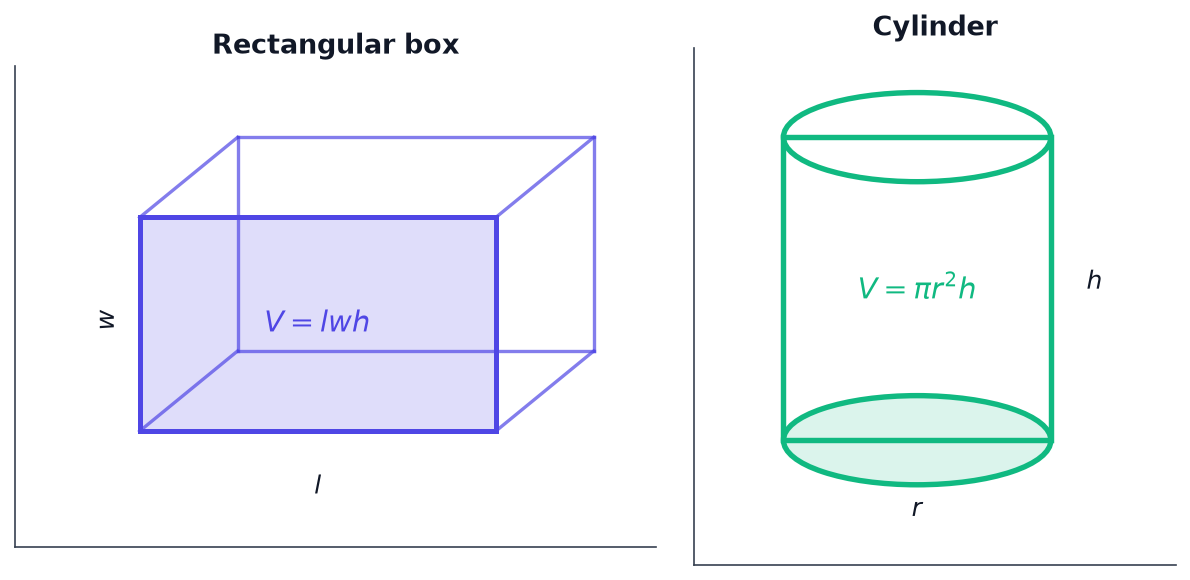
The Rectangular Box
A box has length $l$, width $w$, and height $h$. Its volume is the product of all three:
The reasoning is straightforward. The base has area $lw$, and stacking that base up through the height $h$ multiplies it once more.
Worked example. A room measures $5$ m long, $4$ m wide, and $2.5$ m high.
A related quantity is surface area, the total area of all six faces:
Surface area is what you would need for painting or wrapping; volume is what you need for filling.
Prisms
A prism is any solid with identical cross-sections stacked along its length. The general rule unifies boxes and cylinders:
For a triangular prism the cross-section is a triangle, so
This single formula replaces a list of separate ones to memorise.
The Cylinder
A cylinder is a prism whose cross-section is a circle. With radius $r$ and height $h$,
The term $\pi r^2$ is simply the area of the circular base, multiplied by the height — exactly the general prism rule.
Worked example. A tin has radius $3$ cm and height $10$ cm.
To find how much fits inside in litres, remember that $1000 \text{ cm}^3 = 1$ litre, so this tin holds about $0.283$ litres.
Pyramids and Cones
Halving the matching prism gives a pyramid or a cone:
where $B$ is the area of the base. The factor of one third is surprising the first time it appears, but it is exact.
Units and Capacity in Practice
Volume formulas are unforgiving about units, so a short checklist helps. Convert every dimension to the same unit before multiplying; mixing metres and centimetres silently inflates the answer by a factor of ten thousand. Then confirm the result carries cubic units, which is the quickest signal that all three dimensions were used.
Two conversions cover most real situations. Since a centimetre cube holds one millilitre,
Worked example. A fish tank measures $80$ cm long, $40$ cm wide, and $45$ cm high.
That is the volume of the container itself. Water never fills it completely, and a practical rule of thumb leaves about ten percent freeboard at the top, so you would order closer to $130$ litres of water rather than the full figure. This distinction between internal volume and usable volume appears constantly in cooking, packaging, and shipping, and it is worth keeping in mind whenever a calculation is being used to make a purchasing decision.
Common Mistakes to Watch For
The most frequent error is mixing units before multiplying. Converting one dimension to metres and leaving the others in centimetres produces nonsense, so harmonise every measurement first. A second slip is squaring the radius when finding volume rather than squaring it only for the base area. Always ask whether you are computing a base area or a volume, and check that your final units are cubic.
Key takeaway: find the cross-sectional area first, then multiply by the height, and verify the result carries cubic units.
Practice it: try the equation solver or generate a practice set on this topic.